Research

The advances in Human-AI Collaboration demonstrate the exciting potential to expand human capabilities and improve the quality of work, particularly when working with large amounts of data or complex and ambiguous scenarios. However, the success of this collaboration is predicated upon the ability of humans and AI to effectively communicate, which involves the ability to understand each other and to efficiently present information to each other.

Human-Agent Communication

The human-agent communication paradigm opens exciting opportunities to exploit a computer's unique abilities to complement humans. First, we need to understand the specifics of human-agent communication.

AI-Based Decision Support Systems (ADS)

We explore what aspects of augmentation are required in different scenarios, how the outcomes should be communicated and explained, and how to calibrate and, if needed, repair trust in a system's performance.

Information Architecture for Conversational UI

We explore the perceived locations, structure and paths of the information shared through conversational interfaces, to inform the information architecture they need.

The Cycle of Human-AI Collaboration

Framework

How a person and a system reach a task outcome together

Our research projects explore different stages of the Human-AI Collaboration cycle to gain a holistic understanding of the underlying mechanisms and to lead the development of effective, efficient, and ethical Human-AI collaborating teams.
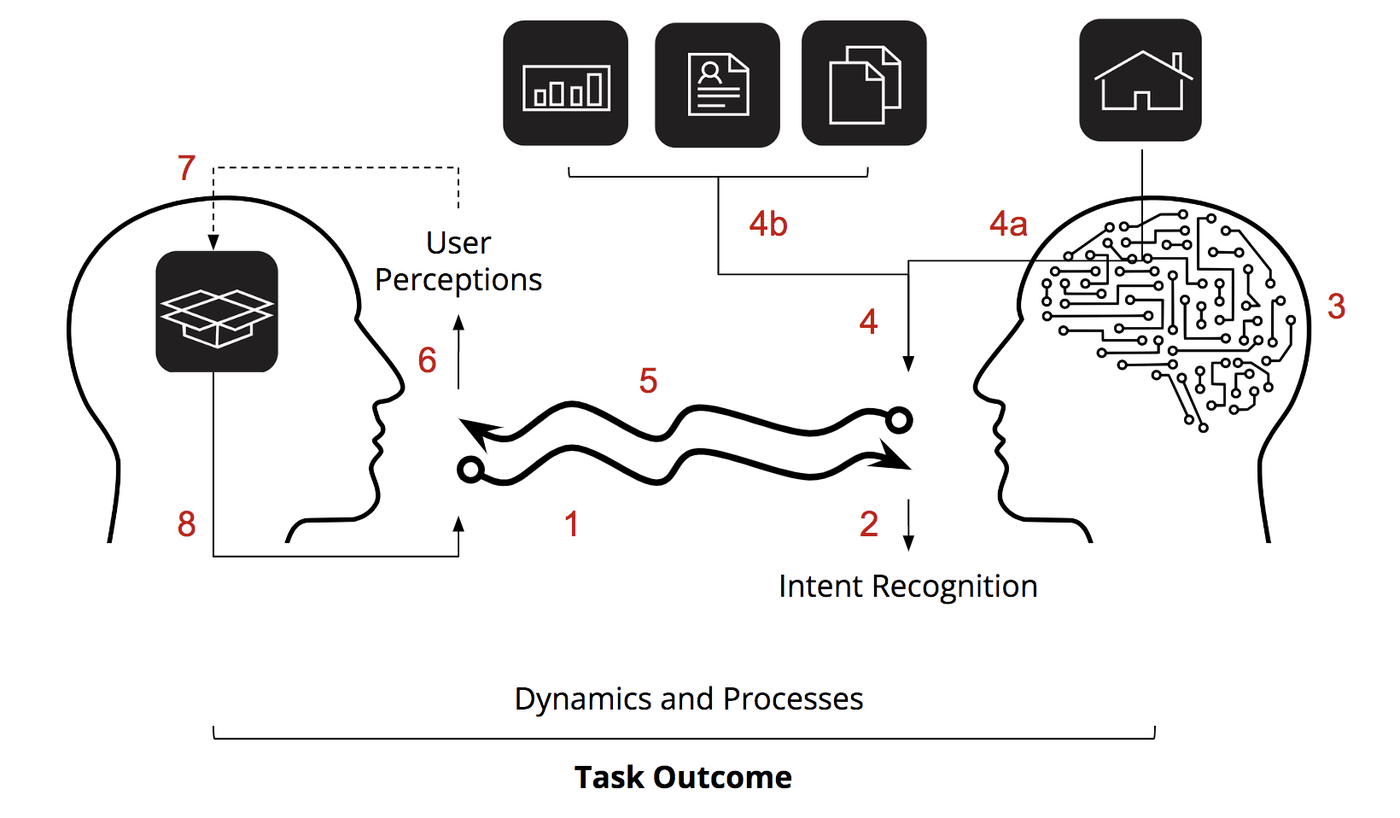
The cycle of human-AI collaboration, steps 1 to 8
  1. 1A human user presents some communicative input.
  2. 2The system recognizes the intent of this input.
  3. 3The system produces information according to the intent.
  4. 4It formats this (internal, 4a) and other required (external, 4b) information for human understanding.
  5. 5It communicates the result back to the user.
  6. 6What is communicated, and how, affects the user's perceptions of the information and of the system.
  7. 7These perceptions further influence the user's mental model and beliefs about the system.
  8. 8Based on in-situ perceptions and overall beliefs, the user formulates the next communicative input with a corresponding intent.

The mechanisms defining how each step proceeds are inevitably affected by contextual dynamics (e.g. systematic differences between users) and might differ for specific processes (e.g. financial decision-making, creativity support, education), but the common goal of this collaboration is to bring better task outcomes while ensuring positive social impact.

From interaction to communication

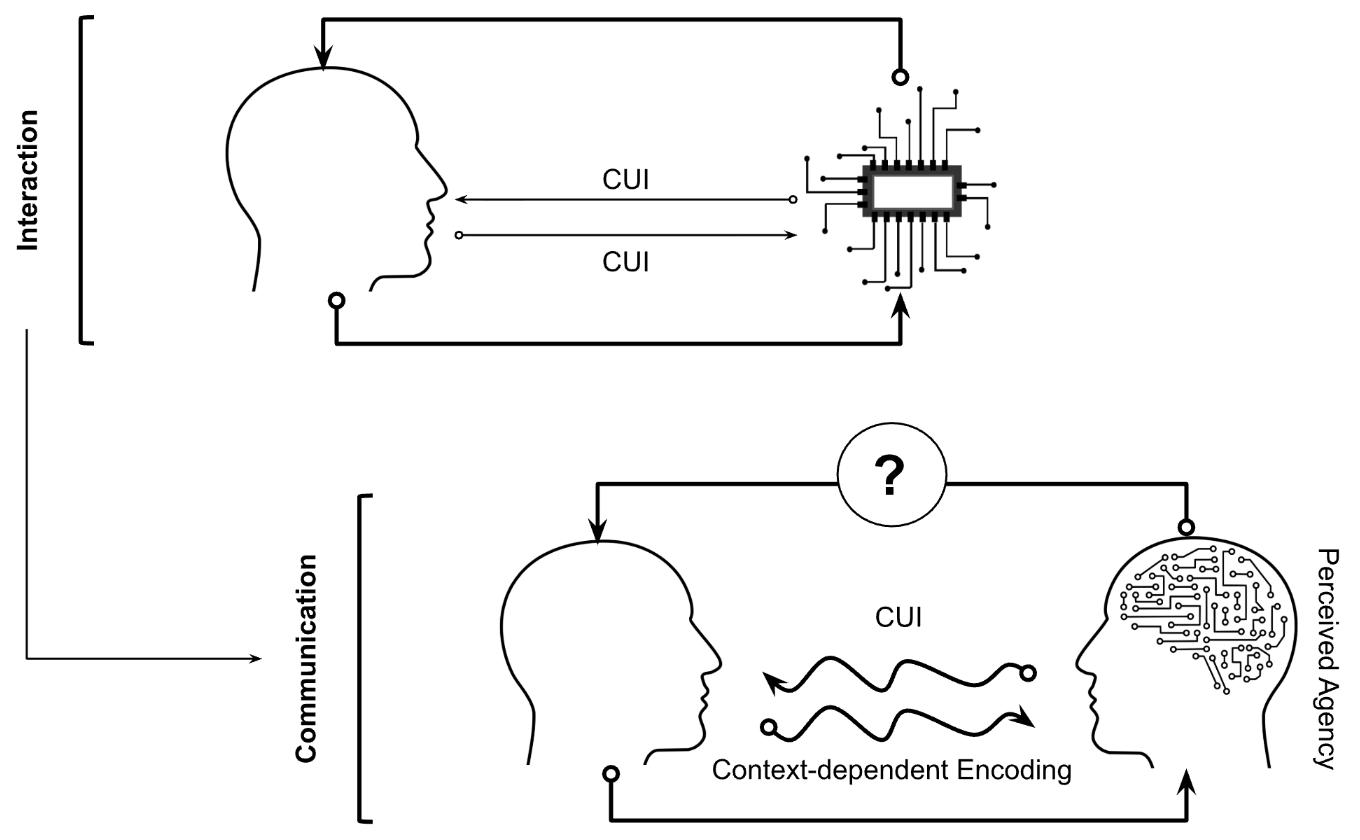
In classical interaction, a defined input from a person gives a defined outcome from a machine. Simple conversational interfaces work the same way: a straightforward request gets a straightforward reply.

Communication is a special type of interaction with perceived agency on the receiving side. People start adapting their input to affect how the system interprets it, so the meaning they encode depends on the context. For this to work in both directions, the system has to synthesize its output according to that contextual meaning.

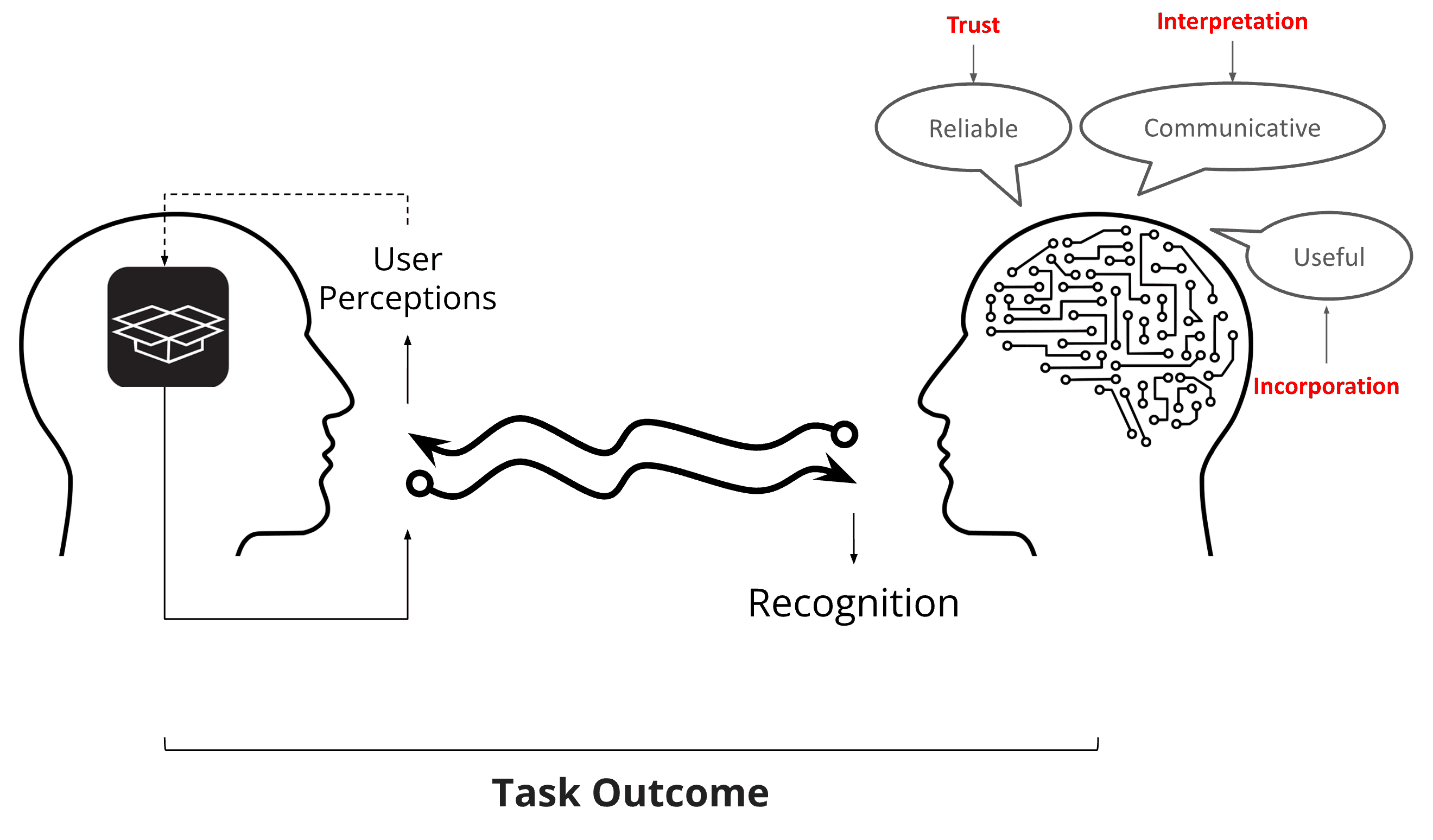
The group studies these parts together: how a system recognizes what people mean, how people perceive the system, and how its output shapes trust, interpretation and incorporation into a task outcome.

Two diagrams. Interaction: a person and a chip exchange defined inputs and outputs through a conversational interface. Communication: a person and an AI with perceived agency exchange messages through context-dependent encoding.
Interaction and communication
Diagram of user perceptions, recognition and the system qualities reliable, communicative and useful, linked to trust, interpretation and incorporation and to the task outcome.
From recognition and user perceptions to the task outcome
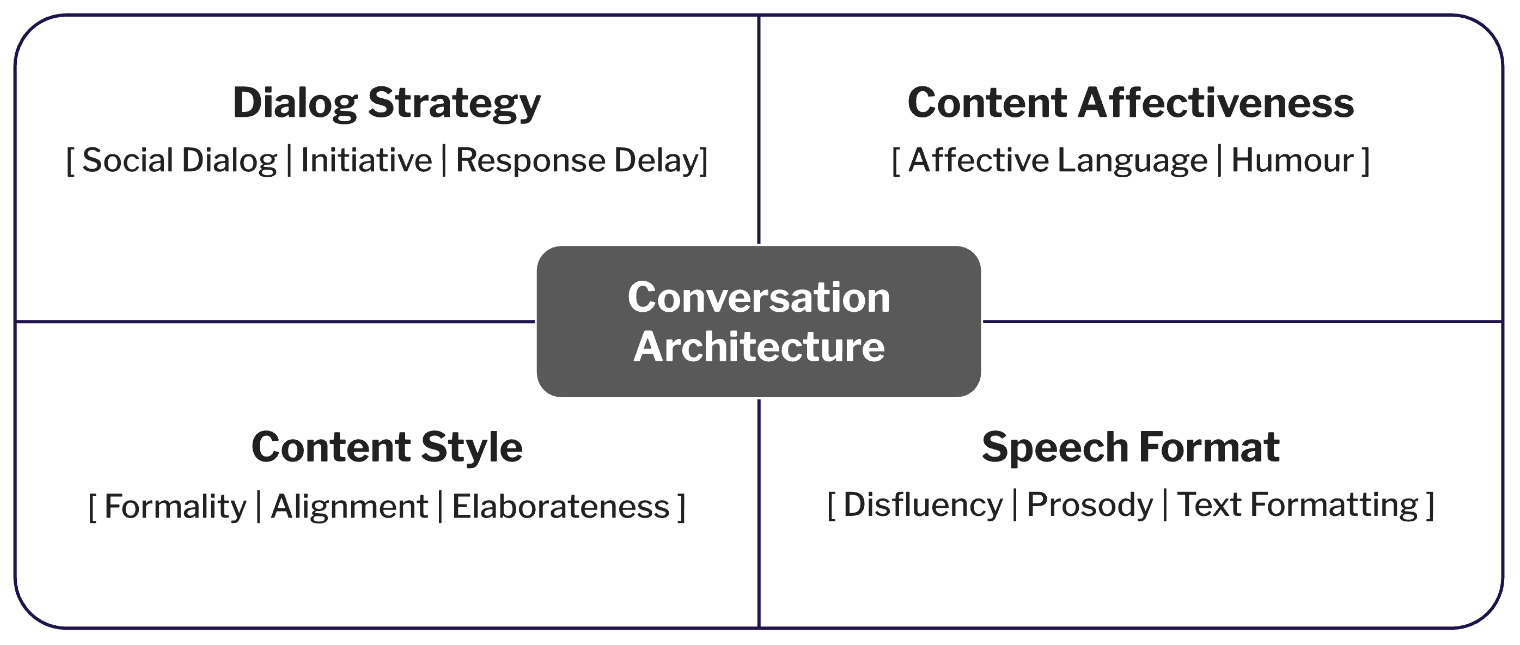
Quadrant diagram of conversation architecture: dialog strategy, content affectiveness, content style and speech format.
Elements of conversation architecture
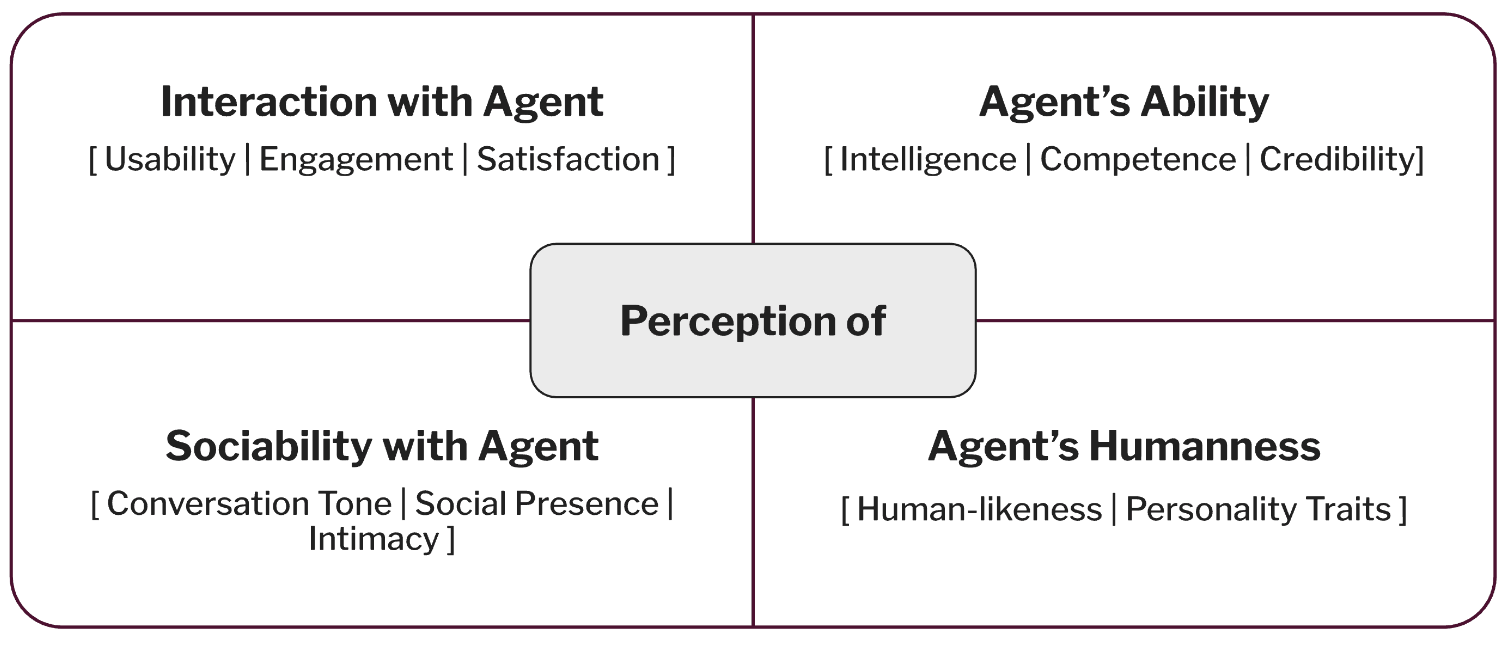
Quadrant diagram of perceptions of agents: interaction with the agent, the agent’s ability, sociability with the agent and the agent’s humanness.
Aspects of how people perceive agents

Figures from Anastasia Kuzminykh’s talk “AI on Speaking Terms: The Role of Communication in Human-AI Collaboration”.

Conversational agents

Human-Agent Communication

The growing complexity of intelligent systems creates a promising environment for a shift in the user experience paradigm: from pure human-system interaction to human-system communication and collaboration. This is further amplified by the increased popularity of entity-based system interfaces (artificial agents) and the integration of conversational user interfaces (CUI). The human-agent communication paradigm opens exciting opportunities to exploit a computer's unique abilities to complement humans. However, first, we need to understand the specifics of human-agent communication.

Decision support

AI-Based Decision Support Systems (ADS)

AI-integrated decision-making support systems augment and extend human capabilities, improving the quality and efficiency of decisions. These systems use AI to learn, remember, analyze, and reason based on large amounts of often complex data. The successful use of these features requires an understanding of how they can appropriately complement human processes. We explore what aspects of augmentation are required in different scenarios, how the outcomes should be communicated and explained (xAI), and how to properly calibrate and, if needed, repair trust in systems' performance.

Conversational UI

Information Architecture for Conversational UI

The intuitive nature of Conversational User Interfaces (CUI), fashioned after natural human conversation, allows for convenient and fast input and can serve as a single-channel input for multiple services, devices, applications, and even environments. However, due to the absence of visual clues, affordances, and spatial organization, the use of CUI is associated with a decreased sense of control over the information dynamics. We explore the perceived “locations”, “structure”, and “paths” of the information shared through CUI, to inform the required information architecture.

  • Chart What I Say

    Exploring Cross-Modality Prompt Alignment in AI-Assisted Chart Authoring

    Generative AIConversational Agents
    CHI EA 2024 Code Dataset on GitHub
  • Naturally Together

    A Systematic Approach for Multi-User Interaction With Natural Interfaces

    Conversational AgentsRemote Collaboration
    CSCW 2021 ACM DL

Datasets and code

Datasets and code from our studies are published on the group's GitHub organization. The Resources page lists further datasets.

CookieLab-UofT on GitHub